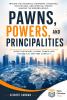
PAWNS, POWERS, AND PRINCIPALITIES: Secret Networks, Global Power, and the Biblical End-Time Conflict
Keywords:
secret networks, global power, global governance, information control, biblical prophecy, spiritual warfare, Christian discernmentSynopsis
Pawns, Powers, and Principalities: Secret Networks, Global Power, and the Biblical End-Time Conflict is an interdisciplinary investigation of how secrecy, concentrated wealth, elite networks, institutional influence, covert action, technological infrastructure, information control, and transnational governance have shaped modern political and social life, and how these developments should be understood within a biblical theology of spiritual conflict and eschatological hope.
Rather than assuming that history is controlled by a single hidden organization, the book develops a rigorous evidentiary framework for distinguishing documented fact from association, inference, allegation, ideological convergence, structural concentration, covert coordination, and speculation. Primary documents, archival records, government investigations, institutional publications, legal materials, financial records, and specialist scholarship are placed in critical dialogue with influential investigative writers whose claims have shaped modern discussions of hidden power. Throughout, the study applies calibrated evidentiary categories and actively tests counter-evidence, recognizing both the historical reality of secrecy and conspiracy and the dangers of exaggeration, circular citation, collective blame, and unfalsifiable theories.
Beginning with the biblical foundations of spiritual rebellion and the moral problem of human power, the historical investigation proceeds through ancient and early modern secret associations, the Bavarian Illuminati, revolutionary movements, banking and financial leverage, the Rhodes-Milner-Round Table milieu, policy institutions such as the Council on Foreign Relations and Chatham House, Bilderberg, the Trilateral Commission, and the controversial Committee of 300 thesis. It then examines the institutional mechanisms through which influence can become durable, including foundations, education, public relations, behavioral science, intelligence agencies, covert operations, surveillance, population policy, environmental planning, and the formation of public consciousness.
The analysis subsequently turns to the emerging architecture of global governance. It examines public-private coordination, multistakeholder institutions, digital identity, biometrics, central bank digital currencies, tokenized finance, global health governance, artificial intelligence, interoperable infrastructure, platform power, algorithmic visibility, content moderation, synthetic media, and the growing capacity of modern systems to identify, classify, persuade, authorize, monitor, restrict, and exclude at scale. The book concludes that significant transnational coordination and technological capacity are demonstrable, while the evidence does not establish a presently existing, unitary secret world government exercising comprehensive command.
The final chapters bring these findings into disciplined dialogue with biblical prophecy. Daniel, Matthew 24, 2 Thessalonians 2, Revelation 13, and Revelation 17–18 are examined without turning contemporary institutions or technologies into premature prophetic fulfillments. The book argues that modern political, financial, informational, and technological infrastructures may constitute historically significant enabling capacities for forms of control described in Scripture, while insisting that capability is not fulfillment and resemblance is not proof. Within a futurist, premillennial, pre-tribulation framework, the climactic issue is ultimately one of worship and allegiance: whether humanity submits to God or absolutizes political, economic, technological, and spiritual power in rebellion against Him.
The book therefore ends not in fear, political obsession, or fascination with secret knowledge, but in a Christian summons to repentance, truth, holiness, discernment, courage, faithful witness, local-church fidelity, evangelism, and readiness for the Blessed Hope. Its final claim is Christological: human empires pass, hidden schemes are exposed, Babylon falls, Satan is judged, and Jesus Christ reigns. The Christian task is not to decode every secret before the world does, but to remain faithful to the Lamb who is sovereign over history and who will make all things new.
Chapters
-
BEHIND THE VISIBLE WORLDWhy This Investigation Matters
-
Settings How to Investigate Hidden Power Without Losing the Truth
-
THE ANCIENT SPIRITUAL REBELLIONThe Biblical Background of Earthly Power
-
SECRET SOCIETIES BEFORE THE MODERN AGEA HISTORICAL AND THEOLOGICAL INQUIRY
-
ADAM WEISHAUPT AND THE BAVARIAN ILLUMINATIARCHIVE, ORGANIZATION, AMBITION, SUPPRESSION, AND THE QUESTION OF SURVIVAL
-
REVOLUTION AS AN INSTRUMENTOF TRANSFORMATIONGRIEVANCE, ORGANIZATION, FOREIGN INTERVENTION, FINANCE, PROPAGANDA, AND THE POLITICS OF EXPLOITED CRISIS
-
MONEY, BANKING, DEBT, AND POLITICAL POWERCREDIT, WAR FINANCE, CENTRAL BANKS, INTERNATIONAL INSTITUTIONS,CRISIS, AND THE NEW INFRASTRUCTURE OF MONETARY LEVERAGE
-
THE ROUND TABLE AND THEANGLO-AMERICAN ESTABLISHMENTRhodes, Milner, Curtis, Imperial Federation, and the Architecture of Informal Power
-
FROM INFORMAL NETWORKS TOPOLICY INSTITUTIONSCFR, Chatham House, Think Tanks, Foundations, Expert Networks, and the Institutionalization of Influence
-
BILDERBERG, THE TRILATERAL COMMISSION,AND TRANSNATIONAL ELITEPrivate Convening, Informal Governance, and the Limits of Command
-
THE COMMITTEE OF 300: EVIDENCE, CLAIMS, AND CONTROVERSIESTesting the Most Expansive Hidden-Hierarchy Thesis Against the Documentary Record
-
FOUNDATIONS, EDUCATION, CULTURE, AND THE ENGINEERING OF CONSENTPhilanthropic Power, Knowledge Production, Behavioral Governance, and the Formation of Public Consciousness
-
INTELLIGENCE AGENCIES,COVERT OPERATIONS, AND THEPOLITICS OF SECRECYRegime Change, Psychological Operations, Domestic Surveillance, Secret Experimentation, and Democratic Accountability
-
POPULATION, RESOURCES, ENVIRONMENT, AND GLOBAL PLANNINGDemographic Anxiety, Systems Modeling, Sustainable Development, and the Moral Limits of Managing Humanity
-
FROM GLOBALIZATION TO GLOBAL GOVERNANCEInterdependence, Public-Private Coordination, Digital Infrastructure, and the Question of Accountable Power
-
THE INFORMATION BATTLEFIELD: WHO DEFINES REALITY?Media Gatekeeping, Algorithmic Visibility, Censorship, Synthetic Content, and Christian Discernment in the Age of Platform Power
-
ARE WE WATCHINGBIBLICAL PROPHECY CONVERGE?Prophetic Hermeneutics, Climactic Empire, Deception, Economic Coercion, and the Disciplined Question of Modern Convergence
-
THE ANTICHRIST SYSTEM AND THE COMING CRISIS OF ALLEGIANCEPolitical Authority, False Worship, Economic Exclusion, Deception, and Faithfulness to Christ
-
WHY THE CHURCH MUST BE READYChrist's Promise, Resurrection, the Catching Away, Deliverance from Wrath, Imminence, and the Holy Life of a Waiting Church
-
COME OUT OF BABYLONTHE CHRISTIAN RESPONSERepentance, Truth, Holiness, Courage, Evangelism, Discernment, and the Blessed Hope in an Age of Deception
References