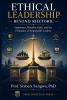
Ethical Leadership Beyond Rhetoric: Legitimacy, Morality, Faith, and the Formation of Responsible Leaders
Keywords:
Ethical LeadershipSynopsis
Ethical Leadership Beyond Rhetoric is a rigorous, practical, and deeply reflective guide to leadership that moves beyond slogans, branding, and public statements of values. In a time when organisations, governments, universities, corporations, and faith-based institutions often speak the language of goics while rewarding compromise, this book asks a more demanding question: what truly verns a leader when integrity becomes costly?
Prof. Sixbert Sangwa develops the Legitimacy-Morality-Faith Framework , a powerful model for evaluating leadership through three essential dimensions. Legitimacy asks whether authority is rightful, accountable, competent, and worthy of trust. Morality asks whether decisions, systems, relationships, and consequences are truthful, just, and respectful of human dignity. Faith asks what ultimate authority governs the leader's conscience, especially in Christian contexts where leadership must be accountable to Scripture and the lordship of Jesus Christ rather than merely decorated with religious language.
Written for scholars, students, executives, entrepreneurs, educators, public servants, pastors, board members, civil-society leaders, and thoughtful citizens, this book integrates leadership studies, moral philosophy, organisational behaviour, institutional theory, African ethical traditions, technology ethics, public governance, business ics, and biblical theology. It examines ethical leadership in professional life, business, education, public service, artificial intelligence, surveillance, global governance, African institution building, faith and work, and Christian leadership under the authority of Scripture.
The book is both critical and constructive. It exposes how ethical language can be used to protect reputation while concealing corruption, coercion, manipulation, institutional injustice, and the concentration of unaccountable power. At the same time, it provides practical tools for diagnosis, ethical decision-making, institutional reform, leadership formation, workshops, university teaching, board reflection tion, and Christian professional pract. ice.
With documented cases, composite dilemmas, analytical tables, diagnostic instruments, seminar questions, applied activities, a glossary, indexes, and extensive appendices, Ethical Leadership Beyond Rhetoric is designed to serve as a serious educational resource for classrooms, libraries, leadership workshops, governance forums, ministry training, professional development, and research.
This is a book for leaders who want integrity to be more than language, for institutions that want accountability to be more than procedure, and for readers who believe that power must be answerable to truth, justice, human dignity, and ultimately to God.
References
African Union. (2024). Continental artificial intelligence strategy: Harnessing AI for
Africa's development and prosperity. African Union Commission. https://au.int/en/documents/20240809/continental-artificial-intelligence-strategy
Aliye, A. A. (2020). African indigenous leadership philosophy and democratic
governance system: Gada's intersectionality with Ubuntu. Journal of Black Studies, 51(7), 727-759. https://doi.org/10.1177/0021934720931963
Alvesson, M., & Einola, K. (2019). Warning for excessive positivity: Authentic
leadership and other traps in leadership studies. The Leadership Quarterly, 30(4), 383-395. https://doi.org/10.1016/j.leaqua.2019.04.001
Amory, J., Wille, B., Wiernik, B. M., & Dupré, S. (2024). Ethical leadership on the
rise? A cross-temporal and cross-cultural meta-analysis of its means, variability, and relationships with follower outcomes across 15 years. Journal of Business Ethics, 194, 455-483. https://doi.org/10.1007/s10551-024-05632-z
Aquino, K., & Reed, A., II. (2002). The self-importance of moral identity. Journal of
Personality and Social Psychology, 83(6), 1423-1440. https://doi.org/10.1037/0022-3514.83.6.1423
Arendt, H. (1970). On violence. Harcourt Brace Jovanovich.
Aristotle. (2000). Nicomachean ethics (R. Crisp, Trans.). Cambridge University Press.
(Original work published ca. 4th century BCE)
Aristotle. (2009). The Nicomachean ethics (D. Ross, Trans.; L. Brown, Ed.). Oxford
University Press. (Original work published ca. 4th century BCE)
Autio, C., Schwartz, R., Dunietz, J., Jain, S., Stanley, M., Tabassi, E., Hall, P., &
Roberts, K. (2024). Artificial intelligence risk management framework: Generative artificial intelligence profile (NIST AI 600-1). National Institute of Standards and Technology. https://doi.org/10.6028/NIST.AI.600-1
Bandura, A. (1999). Moral disengagement in the perpetration of inhumanities.
Personality and Social Psychology Review, 3(3), 193-209. https://doi.org/10.1207/S15327957PSPR0303_3
Bandura, A. (2016). Moral disengagement: How people do harm and live with
themselves. Worth.
Bank for International Settlements. (2024). Embracing diversity, advancing
together: Results of the 2023 BIS survey on central bank digital currencies and crypto. BIS Papers No. 147. https://www.bis.org/publ/bppdf/bispap147.htm
Banks, R. (1999). Redeeming the routines: Bringing theology to life. Baker Academic.
Banks, R., & Ledbetter, B. M. (2004). Reviewing leadership: A Christian evaluation of
current approaches. Baker Academic.
Barnett, M., & Finnemore, M. (2004). Rules for the world: International
organizations in global politics. Cornell University Press. Bazerman, M. H., & Tenbrunsel, A. E. (2011). Blind spots: Why we fail to do what's
right and what to do about it. Princeton University Press.
Beauchamp, T. L., & Childress, J. F. (2019). Principles of biomedical ethics (8th ed.).
Oxford University Press.
Bedi, A., Alpaslan, C. M., & Green, S. (2016). A meta-analytic review of ethical
leadership outcomes and moderators. Journal of Business Ethics, 139(3), 517-536. https://doi.org/10.1007/s10551-015-2625-1
Beetham, D. (2013). The legitimation of power (2nd ed.). Palgrave Macmillan.
Berg, F., Kölbel, J. F., & Rigobon, R. (2022). Aggregate confusion: The divergence of
ESG ratings. Review of Finance, 26(6), 1315-1344. https://doi.org/10.1093/rof/rfac033
Berlin, I. (1969). Four essays on liberty. Oxford University Press.
Boateng, A., Wang, Y., Ntim, C. G., & Elmagrhi, M. H. (2024). Institutions and
corruption relationship: Evidence from African countries. Journal of International Management, 30(3), 101136. https://doi.org/10.1016/j.intman.2024.101136
Bonhoeffer, D. (1955). Ethics (N. H. Smith, Trans.). Macmillan.
Brown, M. E., & Treviño, L. K. (2006). Ethical leadership: A review and future
directions. The Leadership Quarterly, 17(6), 595-616. https://doi.org/10.1016/j.leaqua.2006.10.004
Brown, M. E., Treviño, L. K., & Harrison, D. A. (2005). Ethical leadership: A social
learning perspective for construct development and testing. Organizational Behavior and Human Decision Processes, 97(2), 117-134. https://doi.org/10.1016/j.obhdp.2005.03.002
Buszka, S. G., & Ewest, T. (2019). Integrating Christian faith and work: Individual,
occupational, and organizational influences and strategies. Palgrave Macmillan. https://doi.org/10.1007/978-3-030-22938-5
Campbell, D. T. (1976). Assessing the impact of planned social change. Occasional
Paper Series, 8, 1-65. Dartmouth College, Public Affairs Center.
Carson, D. A. (1991). The Gospel according to John. Eerdmans.
Ciulla, J. B. (2004). Ethics, the heart of leadership (2nd ed.). Praeger.
Ciulla, J. B. (2020). The search for ethics in leadership, business, and beyond.
Springer. https://doi.org/10.1007/978-3-030-38463-0
Crawford, K. (2021). Atlas of AI: Power, politics, and the planetary costs of artificial
intelligence. Yale University Press.
de Bengy Puyvallée, A. (2024). The rising authority and agency of public-private
partnerships in global health governance. Policy and Society, 43(1), 25-40. https://doi.org/10.1093/polsoc/puad032
Denhardt, J. V., & Denhardt, R. B. (2015). The new public service: Serving, not
steering (4th ed.). Routledge. DiMaggio, P. J., & Powell, W. W. (1983). The iron cage revisited: Institutional
isomorphism and collective rationality in organizational fields. American Sociological Review, 48(2), 147-160. https://doi.org/10.2307/2095101
Ebrahim, A. (2003). Accountability in practice: Mechanisms for NGOs. World
Development, 31(5), 813-829. https://doi.org/10.1016/S0305-750X(03)00014-7
Edmondson, A. (1999). Psychological safety and learning behavior in work teams.
Administrative Science Quarterly, 44(2), 350-383. https://doi.org/10.2307/2666999
Eubanks, V. (2018). Automating inequality: How high-tech tools profile, police, and
punish the poor. St. Martin's Press.
European Union. (2024). Regulation (EU) 2024/1689 of the European Parliament and
of the Council of 13 June 2024 laying down harmonised rules on artificial intelligence. Official Journal of the European Union, L, 2024/1689. https://eur-lex.europa.eu/eli/reg/2024/1689/oj
Eva, N., Robin, M., Sendjaya, S., van Dierendonck, D., & Liden, R. C. (2019). Servant
leadership: A systematic review and call for future research. The Leadership Quarterly, 30(1), 111-132. https://doi.org/10.1016/j.leaqua.2018.07.004
Eyong, J. E. (2019). Leadership for high performance in local councils in Cameroon
and Nigeria: Examining deviant and concordant practices to the philosophy of Ubuntu. Africa Journal of Management, 5(2), 138-161. https://doi.org/10.1080/23322373.2019.1631030
France, R. T. (2007). The Gospel of Matthew. Eerdmans.
Freeman, R. E. (1984). Strategic management: A stakeholder approach. Pitman.
French, J. R. P., Jr., & Raven, B. (1959). The bases of social power. In D. Cartwright
(Ed.), Studies in social power (pp. 150-167). Institute for Social Research.
Gilligan, C. (1982). In a different voice: Psychological theory and women's
development. Harvard University Press.
Goldingay, J. (2003). Old Testament theology: Israel's gospel (Vol. 1). InterVarsity
Press.
Goossen, R. J., & Stevens, R. P. (2013). Entrepreneurial leadership: Finding your
calling, making a difference. InterVarsity Press.
Greenleaf, R. K. (1977). Servant leadership: A journey into the nature of legitimate
power and greatness. Paulist Press.
Gyekye, K. (1997). Tradition and modernity: Philosophical reflections on the African
experience. Oxford University Press.
Habermas, J. (1990). Moral consciousness and communicative action (C. Lenhardt &
S. W. Nicholsen, Trans.). MIT Press.
Hoch, J. E., Bommer, W. H., Dulebohn, J. H., & Wu, D. (2018). Do ethical, authentic,
and servant leadership explain variance above and beyond transformational leadership? A meta-analysis. Journal of Management, 44(2), 501-529. https://doi.org/10.1177/0149206316665461 Illes, A., Kosse, A., & Wierts, P. (2025). Advancing in tandem: Results of the 2024 BIS
survey on central bank digital currencies and crypto (BIS Papers No. 159). Bank for International Settlements. https://www.bis.org/publ/bppdf/bispap159.htm
International Monetary Fund. (2024). Central bank digital currency: Progress and
further considerations (Policy Paper No. 2024/052). https://www.imf.org/en/publications/policy-papers/issues/2024/11/08/ central-bank-digital-currency-progress-and-further-considerations-557194
Jensen, M. C. (2002). Value maximization, stakeholder theory, and the corporate
objective function. Business Ethics Quarterly, 12(2), 235-256. https://doi.org/10.2307/3857812
Jones, T. M. (1991). Ethical decision making by individuals in organizations: An
issue-contingent model. Academy of Management Review, 16(2), 366-395. https://doi.org/10.5465/amr.1991.4278958
Judicial Commission of Inquiry into Allegations of State Capture, Corruption and
Fraud in the Public Sector Including Organs of State. (2022). Report of the Judicial Commission of Inquiry into Allegations of State Capture. Government of South Africa. https://www.statecapture.org.za/site/information/reports
Kant, I. (2012). Groundwork of the metaphysics of morals (M. Gregor & J.
Timmermann, Trans. & Eds.; rev. ed.). Cambridge University Press. (Original work published 1785)
Kaptein, M. (2008). Developing and testing a measure for the ethical culture of
organizations: The corporate ethical virtues model. Journal of Organizational Behavior, 29(7), 923-947. https://doi.org/10.1002/job.520
Keller, T., & Alsdorf, K. L. (2012). Every good endeavor: Connecting your work to
God's work. Dutton.
Kidder, R. M. (1995). How good people make tough choices: Resolving the dilemmas
of ethical living. William Morrow.
Langberg, D. (2020). Redeeming power: Understanding authority and abuse in the
church. Brazos Press.
Legood, A., van der Werff, L., Lee, A., & den Hartog, D. N. (2021). A meta-analysis of
the role of trust in the leadership-performance relationship. European Journal of Work and Organizational Psychology, 30(1), 1-22. https://doi.org/10.1080/1359432X.2020.1819241
Lessig, L. (2013). Institutional corruptions. Edmond J. Safra Working Papers, 1.
Harvard University. https://doi.org/10.2139/ssrn.2233582
Lukes, S. (2005). Power: A radical view (2nd ed.). Palgrave Macmillan.
MacIntyre, A. (2007). After virtue: A study in moral theory (3rd ed.). University of
Notre Dame Press.
Mayer, R. C., Davis, J. H., & Schoorman, F. D. (1995). An integrative model of
organizational trust. Academy of Management Review, 20(3), 709-734. https://doi.org/10.5465/amr.1995.9508080335 Mbiti, J. S. (1969). African religions and philosophy. Heinemann.
Metz, T. (2011). Ubuntu as a moral theory and human rights in South Africa.
African Human Rights Law Journal, 11(2), 532-559.
Mill, J. S. (2001). Utilitarianism (G. Sher, Ed.). Hackett. (Original work published
1863)
Miller, D. W. (2007). God at work: The history and promise of the faith at work
movement. Oxford University Press.
Minatti, W. (2024). Legitimate governance in international politics: Towards a
relational theory of legitimation. Review of International Studies, 50(4), 662-681. https://doi.org/10.1017/S0260210524000111
Mkhize, N., Moyo, S., & Mahoa, S. (2024). African solutions to African problems: A
narrative of corruption in postcolonial Africa. Cogent Social Sciences, 10(1), 2327133. https://doi.org/10.1080/23311886.2024.2327133
Moore, C., Detert, J. R., Treviño, L. K., Baker, V. L., & Mayer, D. M. (2012). Why
employees do bad things: Moral disengagement and unethical organizational behavior. Personnel Psychology, 65(1), 1-48. https://doi.org/10.1111/j.1744-6570.2011.01237.x
Morrison, E. W. (2014). Employee voice and silence. Annual Review of
Organizational Psychology and Organizational Behavior, 1, 173-197. https://doi.org/10.1146/annurev-orgpsych-031413-091328
Muller, J. Z. (2018). The tyranny of metrics. Princeton University Press.
Mungiu-Pippidi, A. (2015). The quest for good governance: How societies develop
control of corruption. Cambridge University Press.
National Institute of Standards and Technology. (2023). Artificial intelligence risk
management framework (AI RMF 1.0) (NIST AI 100-1). U.S. Department of Commerce. https://doi.org/10.6028/NIST.AI.100-1
Ng, T. W. H., & Feldman, D. C. (2015). Ethical leadership: Meta-analytic evidence of
criterion-related and incremental validity. Journal of Applied Psychology, 100(3), 948-965. https://doi.org/10.1037/a0038246
Nkomo, S. M. (2011). A postcolonial and anti-colonial reading of “African”
leadership and management in organization studies: Tensions, contradictions and possibilities. Organization, 18(3), 365-386. https://doi.org/10.1177/1350508411398731
Noble, S. U. (2018). Algorithms of oppression: How search engines reinforce racism.
New York University Press.
Noddings, N. (2013). Caring: A relational approach to ethics and moral education
(2nd ed.). University of California Press.
North, D. C. (1990). Institutions, institutional change and economic performance.
Cambridge University Press.
Northouse, P. G. (2022). Leadership: Theory and practice (9th ed.). Sage.
O'Neil, C. (2016). Weapons of math destruction: How big data increases inequality
and threatens democracy. Crown. Oakley, L., & Kinmond, K. (2013). Breaking the silence on spiritual abuse. Palgrave
Macmillan.
Ogunfowora, B., Nguyen, V. Q., Steel, P., & Hwang, C. C. (2022). A meta-analytic
investigation of the antecedents, theoretical correlates, and consequences of moral disengagement at work. Journal of Applied Psychology, 107(5), 746-775. https://doi.org/10.1037/apl0000912
Ordóñez, L. D., Schweitzer, M. E., Galinsky, A. D., & Bazerman, M. H. (2009). Goals
gone wild: The systematic side effects of overprescribing goal setting. Academy of Management Perspectives, 23(1), 6-16. https://doi.org/10.5465/amp.2009.37007999
Organisation for Economic Co-operation and Development. (2025). Steering AI's
future: Strategies for anticipatory governance (OECD Artificial Intelligence Papers No. 32). OECD Publishing. https://doi.org/10.1787/5480ff0a-en
Ostrom, E. (2010). Beyond markets and states: Polycentric governance of complex
economic systems. American Economic Review, 100(3), 641-672. https://doi.org/10.1257/aer.100.3.641
Peng, A. C., & Kim, D. (2020). A meta-analytic test of the differential pathways
linking ethical leadership to normative conduct. Journal of Organizational Behavior, 41(4), 348-368. https://doi.org/10.1002/job.2427
Persson, A., Rothstein, B., & Teorell, J. (2013). Why anticorruption reforms fail:
Systemic corruption as a collective action problem. Governance, 26(3), 449-471. https://doi.org/10.1111/j.1468-0491.2012.01604.x
Plantinga, A. (2000). Warranted Christian belief. Oxford University Press.
Podsakoff, P. M., MacKenzie, S. B., Lee, J.-Y., & Podsakoff, N. P. (2003). Common
method biases in behavioral research: A critical review of the literature and recommended remedies. Journal of Applied Psychology, 88(5), 879-903. https://doi.org/10.1037/0021-9010.88.5.879
Porter, M. E., & Kramer, M. R. (2011). Creating shared value. Harvard Business
Review, 89(1/2), 62-77.
Price, T. L. (2008). Leadership ethics: An introduction. Cambridge University Press.
Ramose, M. B. (1999). African philosophy through Ubuntu. Mond Books.
Rawls, J. (1971). A theory of justice. Harvard University Press.
Rawls, J. (1993). Political liberalism. Columbia University Press.
Rest, J. R. (1986). Moral development: Advances in research and theory. Praeger.
Rose-Ackerman, S., & Palifka, B. J. (2016). Corruption and government: Causes,
consequences, and reform (2nd ed.). Cambridge University Press.
Schein, E. H., & Schein, P. A. (2017). Organizational culture and leadership (5th ed.).
Wiley.
Scott, W. R. (2014). Institutions and organizations: Ideas, interests, and identities
(4th ed.). Sage. Shapiro, J. P., & Stefkovich, J. A. (2016). Ethical leadership and decision making in
education: Applying theoretical perspectives to complex dilemmas (4th ed.). Routledge.
Sipondo, A. (2025). Ubuntu ethical leadership in the African public sector:
Conceptual proposals. International Journal of Public Leadership, 21(2), 140-154. https://doi.org/10.1108/IJPL-10-2024-0119
Slaughter, A.-M. (2004). A new world order. Princeton University Press.
Suchman, M. C. (1995). Managing legitimacy: Strategic and institutional
approaches. Academy of Management Review, 20(3), 571-610. https://doi.org/10.5465/amr.1995.9508080331
Sumanth, J. J., Hannah, S. T., Herbst, K. C., & Thompson, R. L. (2024). Generating the
moral agency to report peers' counterproductive work behavior in normal and extreme contexts: The generative roles of ethical leadership, moral potency, and psychological safety. Journal of Business Ethics, 195, 653-680. https://doi.org/10.1007/s10551-024-05679-y
Taylor, C. (1994). The politics of recognition. In A. Gutmann (Ed.), Multiculturalism:
Examining the politics of recognition (pp. 25-73). Princeton University Press.
Tenbrunsel, A. E., & Messick, D. M. (2004). Ethical fading: The role of self-deception
in unethical behavior. Social Justice Research, 17(2), 223-236. https://doi.org/10.1023/B:SORE.0000027411.35832.53
Tourish, D. (2013). The dark side of transformational leadership: A critical
perspective. Routledge.
Treviño, L. K., & Nelson, K. A. (2021). Managing business ethics: Straight talk about
how to do it right (8th ed.). Wiley.
Treviño, L. K., Brown, M., & Hartman, L. P. (2003). A qualitative investigation of
perceived executive ethical leadership: Perceptions from inside and outside the executive suite. Human Relations, 56(1), 5-37. https://doi.org/10.1177/0018726703056001448
Treviño, L. K., Weaver, G. R., & Reynolds, S. J. (2006). Behavioral ethics in
organizations: A review. Journal of Management, 32(6), 951-990. https://doi.org/10.1177/0149206306294258
Tyler, T. R. (2006). Why people obey the law (2nd ed.). Princeton University Press.
UNESCO. (1997). Recommendation concerning the status of higher-education
teaching personnel. https://www.unesco.org/en/legal-affairs/recommendation-concerning-status-higher-education-teaching-personnel
UNESCO. (2021). Recommendation on the ethics of artificial intelligence.
https://unesdoc.unesco.org/ark:/48223/pf0000380455
United Nations. (2011). Guiding principles on business and human rights:
Implementing the United Nations “Protect, Respect and Remedy” framework. Office of the High Commissioner for Human Rights. https://www.ohchr.org/documents/publications/guidingprinciplesbusines shr_en.pdf United Nations. (2015). Transforming our world: The 2030 Agenda for Sustainable
Development (A/RES/70/1). https://sdgs.un.org/2030agenda
United Nations. (2024). Pact for the Future, Global Digital Compact and Declaration
on Future Generations (A/RES/79/1). https://www.un.org/sites/un2.un.org/files/sotf-pact_for_the_future_adopted.pdf
van Dierendonck, D. (2011). Servant leadership: A review and synthesis. Journal of
Management, 37(4), 1228-1261. https://doi.org/10.1177/0149206310380462
Van Duzer, J. (2010). Why business matters to God: And what still needs to be fixed.
InterVarsity Press.
Vaughan, D. (1996). The Challenger launch decision: Risky technology, culture, and
deviance at NASA. University of Chicago Press.
Volf, M. (1991). Work in the Spirit: Toward a theology of work. Oxford University
Press.
Walton, J. H. (2001). Genesis. Zondervan.
Weber, M. (1978). Economy and society: An outline of interpretive sociology (G. Roth
& C. Wittich, Eds.). University of California Press.
World Bank. (2017). World development report 2017: Governance and the law.
https://doi.org/10.1596/978-1-4648-0950-7
World Bank. (2021). Principles on identification for sustainable development:
Toward the digital age (2nd ed.). https://documents.worldbank.org/en/publication/documents-reports/docu mentdetail/213581486378184357/principles-on-identification-for-sustainable-development-toward-the-digital-age
World Economic Forum. (2024). The global risks report 2024 (19th ed.).
https://www.weforum.org/publications/global-risks-report-2024/
Wright, C. J. H. (2004). Old Testament ethics for the people of God. InterVarsity
Press.
Wright, C. J. H. (2006). The mission of God: Unlocking the Bible's grand narrative.
InterVarsity Press.
Zuboff, S. (2019). The age of surveillance capitalism: The fight for a human future at
the new frontier of power. PublicAffairs.
Zürn, M. (2018). A theory of global governance: Authority, legitimacy, and contestation. Oxford University Press.